
Flat hair is one of those problems that feels personal. Like your hair specifically decided it wanted to lie there, completely lifeless, regardless of what you do to it. You blow dry it upside down, you tease it, you try the round brush technique you watched someone do on a video – and by noon it’s back to exactly where it started. Here’s what most people figure out eventually: the issue usually isn’t the technique. It’s that the products underneath the technique are working against you.
Why Flat Hair Stays Flat
Fine hair and low-density hair have a physics problem. There isn’t enough structural mass to hold lift on its own, so whatever you build during styling collapses as soon as gravity and humidity get involved. That’s not a hair health issue – it’s just how the hair is built.
But the products people reach for often make it worse without anyone realizing. Heavy conditioners, rich leave-ins, thick serums – all of those coat the hair shaft and add weight. On thick or coarse hair that weight is manageable. On fine hair it just pulls everything flat. The hair isn’t broken. It’s just being dragged down by products that weren’t designed for it.
Hair volume products work differently. The formulas built specifically for lift are designed to add structure without mass – thickening the individual hair shaft slightly, giving it something to hold onto during styling, without the weight that kills volume before you’ve even finished blow drying.
The Products That Actually Move the Needle
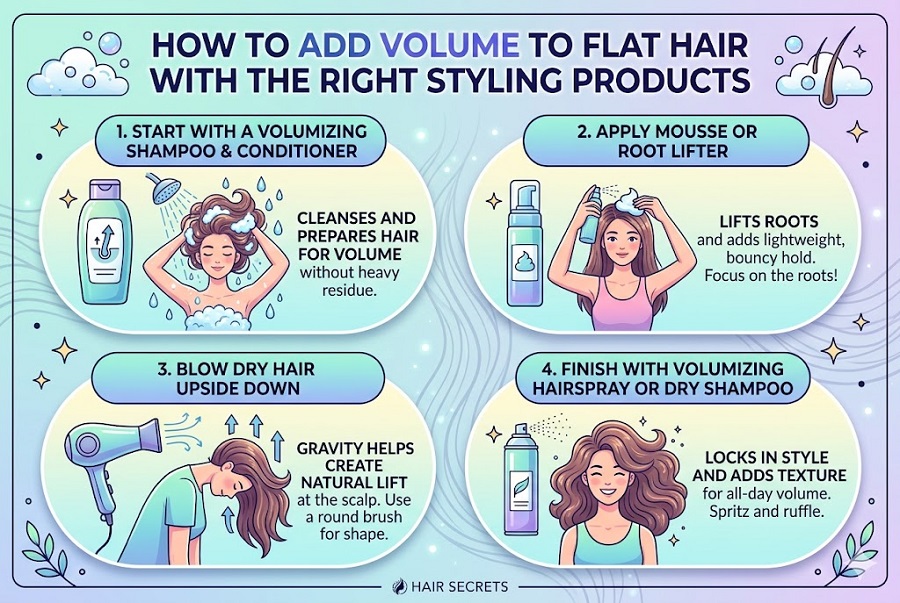
Volumizing mousse has been around long enough that people assume it’s outdated. It isn’t. A good mousse applied to damp hair before blow drying gives the hair a flexible internal structure that holds up through heat styling. The key word is flexible – stiff crunchy mousse is a formula problem, not a category problem. The right one leaves hair touchable.
Root sprays and lift sprays are underused and genuinely effective. Applied directly at the root on damp hair before drying, they create a foundation for volume at the base where it matters most. Volume that starts at the root lasts. Volume that starts mid-shaft doesn’t.
Dry texturizing sprays come in at the end – on dry, finished hair – and this is where a lot of people find the most immediate difference. They add grip and separation without adding visible product, which makes the hair look fuller without looking like anything’s been added to it. Among hair volume products, a good texturizing spray is probably the fastest way to see a result on the same day you start using it.
How You Apply It Matters as Much as What You Use
Product selection gets most of the attention but application is where volume is actually won or lost. Applying mousse or volumizing spray to soaking wet hair dilutes the product significantly – it needs damp hair, not dripping hair. Squeeze out or blot excess water first.
Root lifting products need to go on the roots. That sounds obvious until you watch how most people actually apply product – starting mid-length and working toward the ends out of habit. Flip the approach. Roots first, always, especially with hair volume products designed for lift.
The blow dryer angle changes everything too. Drying the hair in the same direction it naturally falls doesn’t build volume – it reinforces flatness. Flip sections upward while drying, use a round brush to lift at the root, and let each section cool before releasing it. Heat builds the shape. Cooling sets it.
Conclusion
Flat hair isn’t a permanent sentence. It’s mostly a product and technique mismatch that’s been running on autopilot for too long. The right hair volume products – used on damp hair, applied at the roots, layered in the right order – change what’s possible without adding weight or stiffness. Get the foundation right during styling and the results hold. Keep using heavy products designed for different hair types and no technique in the world is going to save you. Start with what’s in your hands before you blame what’s on your head.