
DHI and FUE remove hair the same way, one follicle at a time, but they differ in how it goes back in. In classic FUE, the surgeon makes small openings first, while in DHI each follicle is placed directly with an implanter pen. Neither suits everyone, so the surgeon chooses based on your case.
Here is what each technique involves, what it means for you as a patient, and how the choice gets made.
What do DHI and FUE have in common?
DHI is usually described as a variation of FUE (follicular unit extraction). The first half of both procedures is the same.
Grafts, each a natural group of around two to four hairs, are taken out one by one with fine FUE punches. They come from the back and sides of the head, the area where hair tends to hold on longest.
That shared start means a lot is the same for you:
- No stitches. No strip of skin is removed, so there is nothing to stitch.
- Local anaesthesia. You stay awake while the scalp is numbed, and most people feel only mild discomfort, with little or no pain.
- The same growth pattern. Shedding in the first weeks is common with both. New hair usually appears from around month three, with the final look at around a year.
How does classic FUE place the grafts?
In classic FUE, placement happens in two stages. First, the surgeon makes tiny openings across the thinning area. The angle, direction and spacing of those openings decide how the new hair will grow.
Then the grafts are placed into the openings one by one, usually with fine forceps. Because every opening is made before placement begins, the whole layout is mapped out on the scalp in advance.
For you, that pattern of openings is the blueprint for your new hairline. It is worth asking how the surgeon plans it, and how it will frame your face.
How does DHI place the grafts?
In DHI (Direct Hair Implantation), there is no separate stage for making openings. Each follicle is loaded into an implanter pen, a slim tool with a hollow needle, and placed straight into the scalp by hand.
The pen makes the opening and places the graft in a single movement. The surgeon sets the angle and direction of each hair as it goes in.
Some surgeons find this useful when adding grafts between existing hairs. There, the aim is to thicken an area rather than fill a bare one.
For you, it means design and placement happen together, graft by graft. The surgeon’s eye for angle and direction shapes the result at every step.
What difference will you notice as a patient?
Probably less than you expect. Both techniques use local anaesthesia, avoid stitches and follow the same growth timeline.
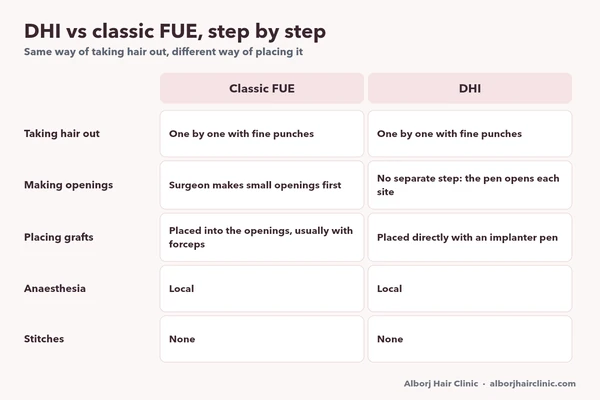
| Classic FUE | DHI | |
|---|---|---|
| Taking hair out | One by one with fine punches | One by one with fine punches |
| Making openings | The surgeon makes small openings first | No separate step; the pen opens each site |
| Placing grafts | Placed into the openings, usually with forceps | Placed directly with an implanter pen |
| Anaesthesia and stitches | Local anaesthesia, no stitches | Local anaesthesia, no stitches |
The real differences sit in the surgeon’s hands. For your look, the planning behind the placement matters more:
- Hair direction. Hairs set at a natural angle lie flat and move with the rest of your hair, which matters for partings and swept styles.
- Hairline shape. A soft, slightly irregular edge usually looks more natural than a ruler-straight line.
- Density where it shows. The hairline and parting are seen first, so many plans give them priority.
Styling while the hair grows is similar with both. The new hair arrives gradually, so many people keep a softer, slightly longer cut that blends the new and existing hair.
How does a surgeon decide which technique suits you?
The decision comes from an examination, not a brochure. The surgeon looks at your donor area, your stage on the Norwood or Ludwig scale, your hair type and the result you want.
Many surgeons work mainly with one technique they know well. Alborj Hair Clinic in Dubai, for example, uses DHI, with each follicle placed by hand.
“Both techniques start the same way, with follicles taken out one by one. I use DHI because placing each follicle directly lets me control its angle and direction as it goes in. But every plan starts with the patient’s own hair, not the name of a technique.”
In other words, a good surgeon explains why a technique suits you. A sales pitch for one method over the other, without looking at your hair, is a warning sign.
What should you ask at a consultation?
A good consultation leaves you understanding the plan, not just the name of the technique. These questions help:
- Which technique will you use, and why does it suit my hair?
- How many grafts do I need, and how did you work that out?
- Where will my hairline sit, and how will it look as I get older?
- Who carries out each part of the procedure?
- What will the first few weeks of healing look like?
Clear, specific answers matter more than the label on the technique.
About Alborj Hair Clinic
Alborj Hair Clinic is a hair transplant clinic in Mazaya Centre, Al Wasl, Dubai. Its surgeon, Dr Dimitrios Ziakas, has 24 years of experience and has performed more than 4,000 hair transplant procedures. He is a member of the International Society of Hair Restoration Surgery (ISHRS) and uses the DHI (Direct Hair Implantation) technique.
Before-and-after case studies on the clinic’s website show how DHI results develop as the new hair grows in.
Frequently asked questions
Is DHI better than FUE?
Neither is better for everyone. In skilled hands both can give natural-looking results, and the surgeon picks the approach that fits your case.
Is recovery different with DHI and FUE?
The growth timeline is the same for both. Your surgeon will give you aftercare instructions for your own procedure.
Will anyone be able to tell which technique I had?
Not from looking. People notice whether a hairline looks natural, which comes down to planning and placement.
Can women have DHI?
Often, yes. DHI can suit women whose thinning follows a pattern and who have enough healthy donor hair, which the surgeon checks at the consultation.